What Is Caricature?
Definition & Techniques
From the Italian word caricare — to load, to charge, to exaggerate. A free illustrated guide to the art of the exaggerated portrait.
What is caricature and where does it come from?
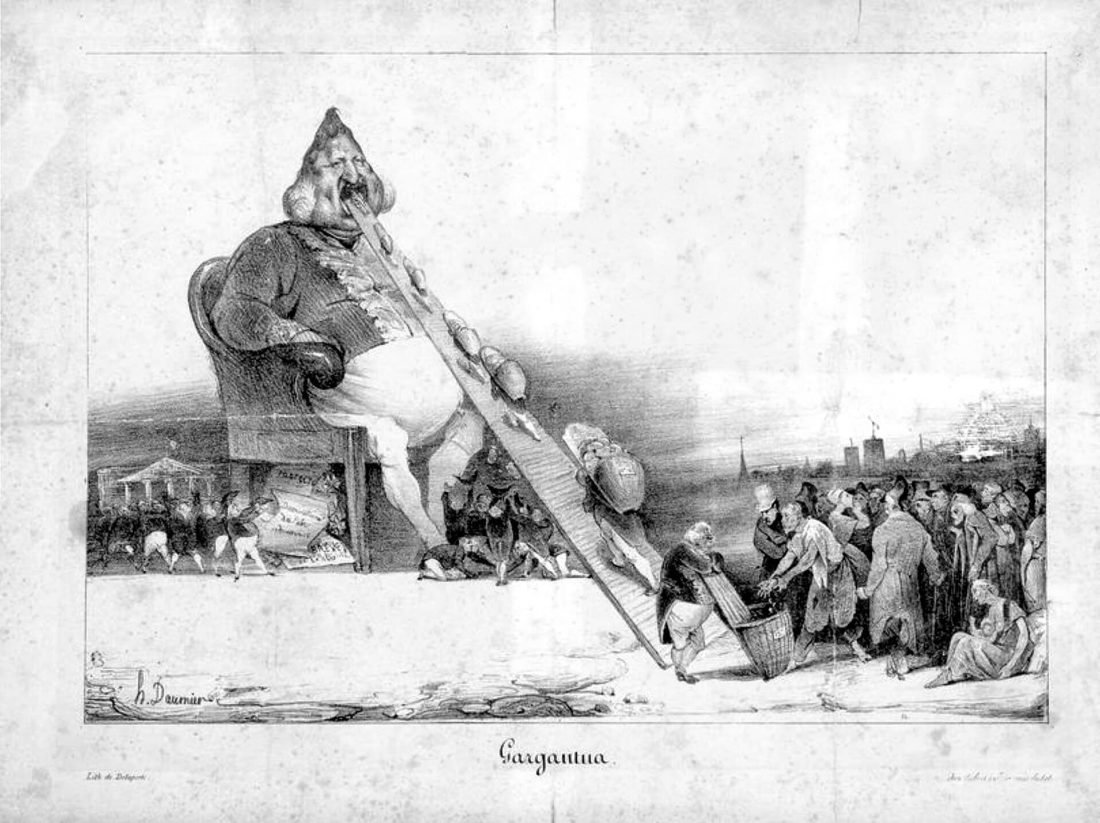
The word “caricature” comes from the Italian caricare, which means “to load” or “to charge”. The caricaturist “charges” a drawing to make it more expressive, to convey a message. It is a weapon for the voiceless and a distorting mirror held up to society.
For Freud, caricature attacks people to whom respect is due — who hold authority. Distortion is not just simple mockery; it is a valorous artifice that tends to an expressive alteration of the model.
How did satirical images spread on a large scale?

Wood Engraving (Woodcut)
The oldest technique. The artist engraves their drawing in relief on a wooden block. The carved-out parts remain white; the raised parts are inked. It allowed the first images of protest to be widely disseminated.
Metal Engraving (Etching)
More precise — the drawing is engraved on a copper or zinc plate covered with varnish, then immersed in acid. The rendering is finer and more detailed, but the process is more expensive. Used by Gillray and Cruikshank.
Why did lithography revolutionise the satirical press?
Discovered at the end of the 18th century, lithography changed everything. Drawing on limestone with greasy ink — the stone hardly wears out, allowing vast, fast and cheap print runs. It is thanks to lithography that caricature invaded newspapers in the 19th century.
Elsewhere in Culture
In brief
- Caricature comes from the Italian caricare, “to load”: the art of exaggerating the features of a face to create an expressive portrait and convey a message.
- Three techniques carried its diffusion: wood engraving (woodcut), metal engraving (etching) and lithography.
- Lithography, discovered at the end of the 18th century, allows very large print runs at low cost: it is thanks to it that caricature invaded newspapers in the 19th century.
- This chapter presents 2 annotated works, including Daumier’s Gargantua (1831), which earned its author a prison sentence.
| Concept / Technique | Artistic Definition | Visual Objective |
|---|---|---|
| Caricare (The Charge) | Accentuation of prominent features | To ridicule or highlight a character trait |
| Portrait-Charge | Systematic distortion of the face | To reveal the “inner truth” of the subject |
| Resemblance | Preservation of visual anchor points | Immediate identification despite the distortion |
— Sébastien Rieu